

Agribusiness Atlas 2026
GPS sensors, cloud-based systems and artificial intelligence are fundamentally reshaping agriculture. A small number of corporations control the market and are pushing farms into ever greater dependence.

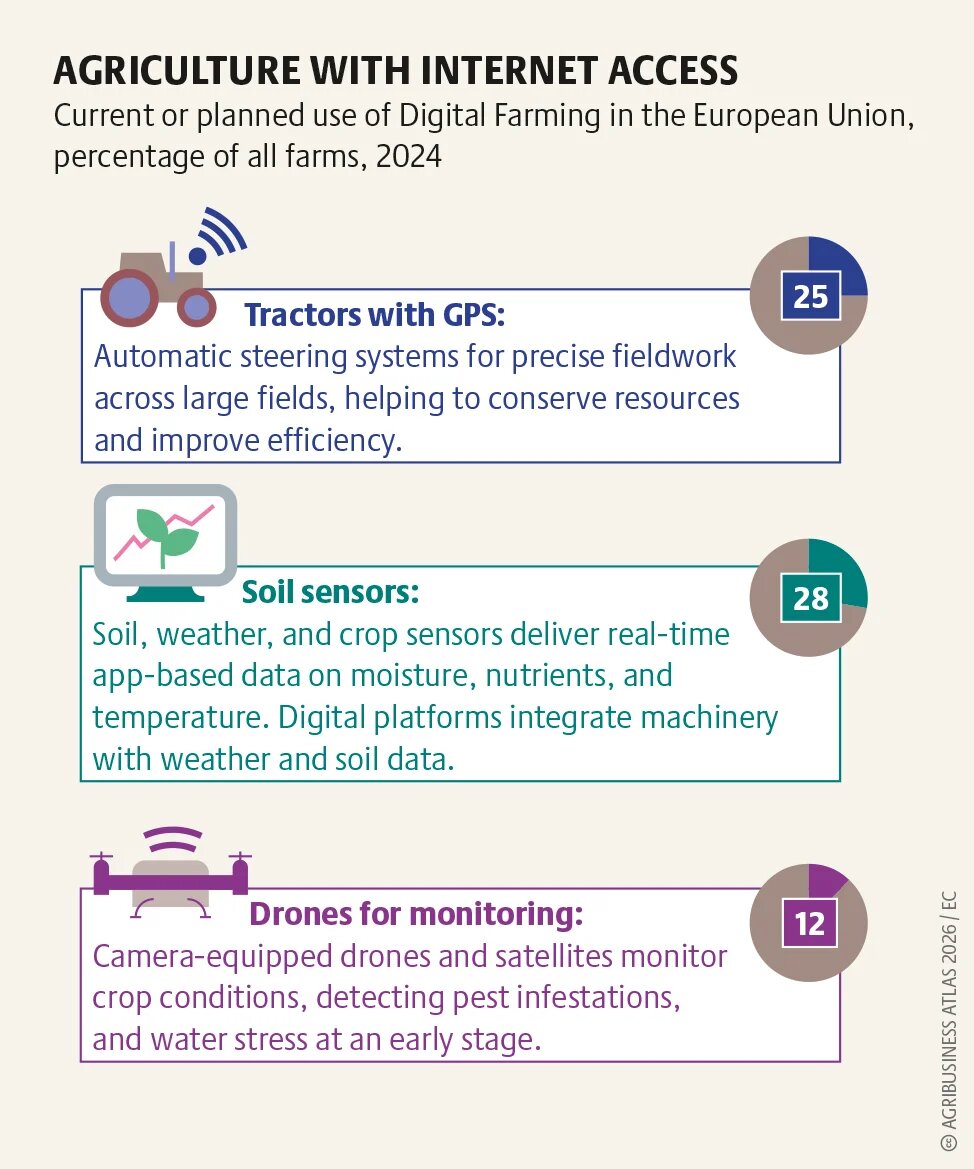
Large agribusiness corporations are purchasing digital technologies or developing them in-house. In practical terms, this development, commonly referred to as Agriculture 4.0, means that tractors and combine harvesters can partially steer themselves using sensors and GPS, while automatically recording the quantities of pesticides and fertilisers applied and the yields across different sections of a field.
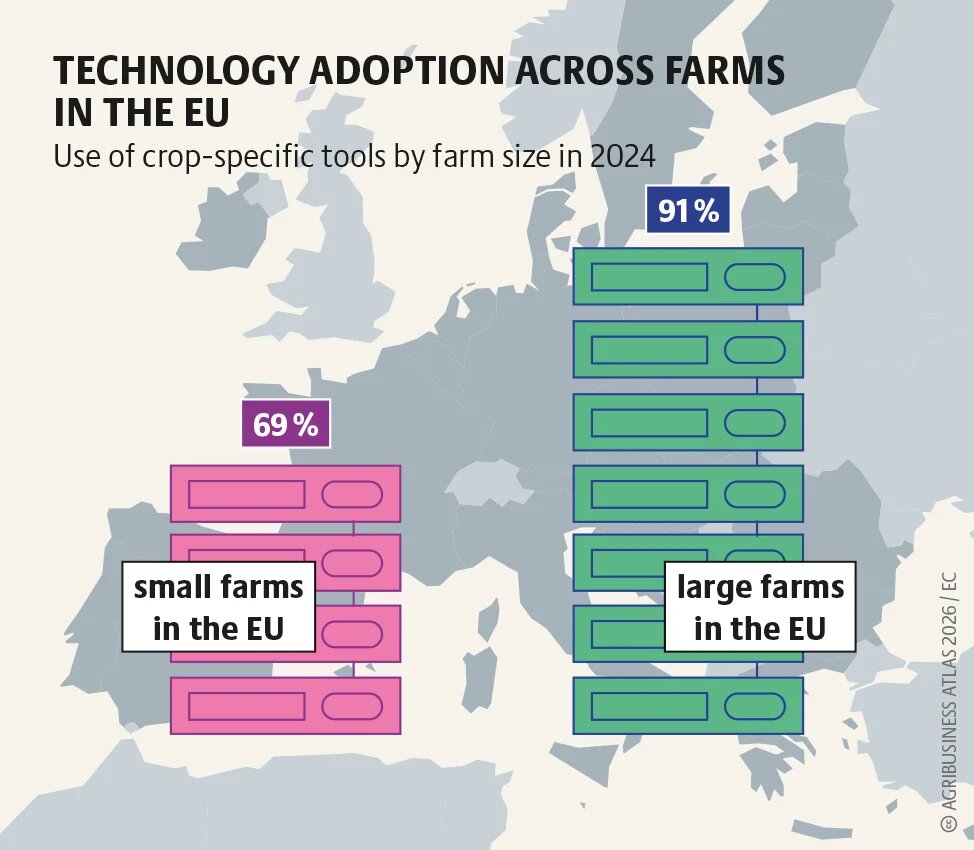
Cloud-based platforms play an increasingly important role in this transformation. When Bayer acquired Monsanto in 2018, it also gained control of the digital platform Climate FieldView. Farmers around the world now use it across a total area of 90 million hectares. In the EU, between 3 and 23 per cent of surveyed farmers use digital tools that go beyond WhatsApp or weather forecasts. Other major agribusiness corporations offer similar services, including BASF with xarvio, Corteva with Granular Insights, John Deere with Operations Center, Syngenta with Cropwise, and Yara with its platform YaraPlus. All these platforms collect data from farms and farm machinery and combine it with publicly available weather and satellite information, for example relating to crop growth. Corporations claim that this will offer farmers a clearer overview of their operations and support decision-making.
Many platforms also provide personalised recommendations. Climate FieldView, for example, shows how Bayer's DEKALB maize seeds can be sown to maximise yields. To do this, the platform uses machine learning, a form of artificial intelligence (AI) that identifies patterns in large datasets, derives insights, and generates forecasts. Depending on a farm s yield targets, the platform suggests, for instance, in which zones seeds should be sown more densely, and when irrigation and harvesting should take place.
At first glance, this may appear to represent progress for farmers. In reality, however, digital agriculture primarily serves the profit motives of agribusiness corporations. As some of their revenues are declining, for example in the pesticides business, digital services and data analysis are becoming increasingly important sources of profit. By digitising agriculture, these corporations gain access to the data of millions of farmers. This allows them to develop products more strategically, market them more precisely, and potentially adjust prices accordingly. For farmers, the platforms create new dependencies. Agricultural knowledge is increasingly replaced by data-driven analysis, and algorithms play an ever greater role in decision-making. Because many platforms actively promote their own products Climate FieldView, for example, promotes Bayer s seeds switching to alternative inputs becomes increasingly difficult. And once data have been uploaded to a platform, they usually cannot be transferred to another platform. This is commonly described as a lock-in effect, whereby users become effectively tied to a particular product with no viable alternatives.
Well-capitalised tech corporations have also moved into agriculture. Since 2024, for example, John Deere has been working with Elon Musk to connect farm machinery to Starlink s satellite network. The aim is to reach rural areas where access to high-speed internet remains limited. Chinese tech giants Alibaba and Tencent have adapted their AI-based chatbots specifically for farmers. These chatbots now provide tailored recommendations to optimise cultivation. Big Tech corporations also supply much of the infrastructure required for the digitalisation of agriculture: many platforms rely on cloud computing and data analysis services provided by Amazon, Microsoft, and Google.
Microsoft is also expanding its presence in the agricultural sector through a cooperation with Bayer. The Azure Data a for agriculture is based on Microsoft's cloud infrastructure. By using data generated by millions of users, Microsoft and Bayer could further expand their market power. The risks are evident: the more dominant a platform becomes, the easier it is for the corporation to exclude other market participants and generate new revenue by charging for access. At the same time, users dependence on the platform would increase further.
This form of market dominance has become a core strategy for profit generation in platform capitalism an economic model in which a small number of actors control key interfaces and are thus able to reshape markets in line with their own interests. Well-known examples include Amazon in online retail and Meta, which dominates social networking through Facebook and Instagram. The socioeconomic effects already observed in these and other sectors now threaten to extend to agriculture.

A handful of corporations dominate our food system, setting prices, profiting from crises, and driving relentless pressure on the environment, farmers, and consumers alike. The Agribusiness Atlas 2026 traces how this concentration of power took hold, and charts the political pathways toward a fairer food system built around the common good.
